Rereading Isidore
Notes
Starting in about 620 CE, Isidore of Seville began compiling a kind of dictionary, the Etymologiae. In it, the Spanish bishop sets out the meanings of a wide range of learned terms along with conjectures about their origins.
Isidore's Latin reference book in 20 volumes provides us with one of the oldest instances of the word stemma being applied to a diagram. For the word's long history since classical times, see my Latin page.
The Etymologiae (also historically called the Origines) is not arranged alphabetically, but by subject. Parts v, vi and vii of Book IX are devoted to kin relationships.
Entry vi.28 offers this definition of the Latin word stemma: By stemmata one denotes the twigs that lawyers draw so they can then measure the degrees of kinship, for example, he's the son, he's the father, he's the grandfather, he's a paternal cousin and so on.[*]Stemmata dicuntur ramusculi, quos advocati faciunt in genere, cum gradus cognationum partiuntur, ut puta: ille filius, ille pater, ille avus, ille agnatus [Patrologia/Reydellet: et cognatus], et ceteri, quorum figurae haec [Patrologia: ...hae sunt]. -- Orig. IX.vi.28 Isidore does not suggest any etymology for stemma, and closes the entry with the indication: These persons are in the diagrams.
The diagrams that follow are three radically different variations of the so-called arbor juris, a matrix diagram which has been used in Roman law systems for two millennia to determine the legal boundaries of kinship. It helps compute for example which kinsfolk may marry without committing incest, which kin are exempt from testifying against an accused, or which kinsfolk may inherit if a person dies without making a testament. [*]That in the Visigothic Codex Euricianum appears to have been drafted in about 475, that in the Notitia Dignitatum in about 400. See: Schadt, Hermann. Die Darstellungen der Arbores Consanguinitatis und der Arbores Affinitatis: Bildschemata in juristischen Handschriften. Tubingen: Wasmuth, 1982. The three matrices which Isidore presents are triangular, rectangular and concentric (the links are to digital manuscripts.[*]This e-Codices manuscript of the Etymologiae now at St. Gallen in Switzerland has been dated to 880-890, some 250 years after Isidore's death.).
Isidore does not explore the three diagrams' legal significance, but merely offers the figures as a kind of scholarly reference, doubtless obtained from some legal text he has seen, in support of the survey of kinship vocabulary which he has just outlined.
The standard interpretation through the centuries— and it is easy to see why scholars would jump to such a conclusion— has been that the figures which Isidore presents after his stemma definition are the self-same stemmata which he has just defined. After all, the matrices— or figurae as Isidore calls them— do include father, son, grandfather and paternal cousin. In the surviving manuscripts of the Etymologiae, the text of the stemma definition is generally copied onto a page of its own and placed above the triangular matrix, as if it were a caption attached to that diagram.
This needs to be questioned. We do not in fact know what ancient jurists called such a matrix. There are almost no clues, though a legal commentary, the Liber singularis et de gradibus adfinibus et nominibus eorum attributed to the jurist Julius Paulus, who flourished in about 200 CE, describes the computation of kin relationships as "like moving on a ladder" (scala) or a mountainside.[*]Gradus autem dicti sunt a similitudine scalarum locurumve proclivium. The Liber singularis no longer exists as an intact text, but can be partly reconstructed. The passage is quoted thus in the Digest of Justinian, 38.10.10.10. See discussion at Schadt, page 24. Schulz, Fritz. Geschichte der römischen Rechtswissenschaft, Weimar, 1961, page 326 ff, attributes the passage to a Late Antique author other than Paulus. One of the diagrams looks very like a ladder (below) and it almost certainly dates back to classical times, so it would be plausible to suppose that the matrix itself might have been referred to, at last informally, as a scala. (Digest 38.10.10.10 at the Latin Library.)
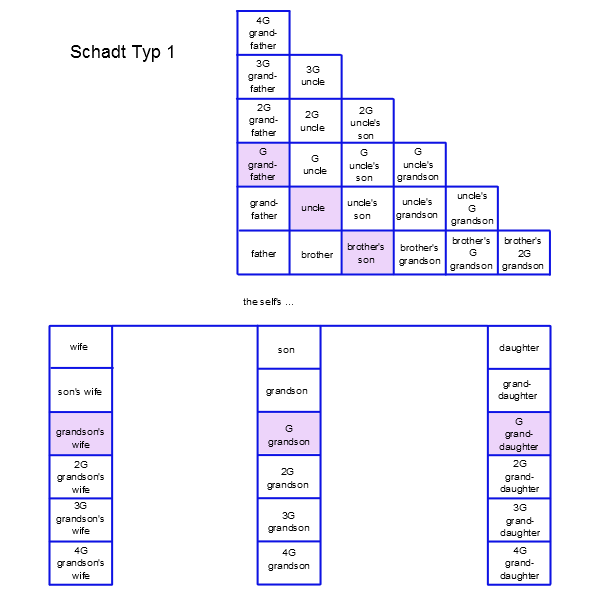
Over the centuries after Isidore, such matrices were to acquire four different technical names [*]Arbor juris, arbor consanguinatis, arbor affinitatis (this one has a slightly different purpose) and stemma. and stemma came to be seen— wrongly in my view— as an appropriate synonym for this type of diagram. The pre-eminent modern analyst of such matrices, Hermann Schadt, uses the term "stemma" throughout his book as a synonym to loosely describe all consanguinity and affinity tables, perhaps for want of any other suitable term that might have embraced them all.
The figure that Schadt denominates Typ 1 (above) is the most ancient of these schemes. However there is no documentary evidence of Typ 1 ever being referred to as a "stemma" in Late Antiquity, although it should be noted that one manuscript presenting this design later gained the name Stemma of Cujas. That designation refers to a French collector, Jacques Cujas, who in 1564 published a 9th-century folio containing such a Typ 1 matrix.[*]Klapisch-Zuber, Christiane. L'Arbre des Familles. Paris: Éd. de La Martinière, c 2003. Here page 32; also Ombre 37. This mislabelling reached an apogee with W.M. Lindsay's modern critical edition of the Etymologiae [*]Lindsay, Wallace Martin (ed). Isidori Hispalensis Episcopi Etymologiarvm sive originvm libri XX. Oxford: Clarendon, 1911. which headlines Isidore's three figurae as Stemma I, II and III.
There are however good grounds for thinking both Lindsay and Schadt were mistaken. Their misapplication of the label "stemma" to these matrices can be traced back to a centuries-long inability among editors and scholars, both medieval and modern, to understand Isidore's intentions from the bishop's poor phrasing.
On both linguistic and practical grounds, one must question whether Isidore really did intend his reader to believe that a matrix was in any sense the same thing as a stemma. Here's why:
1. Isidore describes a stemma as looking like ramusculi, literally small branches or twigs, although none of the tables of consanguinity in any way take the form of twigs.
2. The matrices, especially the triangular form, are eminently unsuitable for mapping out the pedigrees and descent of real-life families. Whereas twig-like diagrams can be split and joined at will, a matrix presents any family solely from the standpoint of a theoretical first person, the ego or ipse.
3. To use a matrix as a documentary record of a real-life family, each cell would have to contain large numbers of kin who among themselves would be only distant cousins. Many other cells would be empty. A triangular matrix would add to the confusion by recording great-great-grandchildren in direct proximity to distant ancestors.
4. The Latin term stemma was demonstrably used in antiquity as an abstract noun to denote the particular genealogy, not a legal scheme or meta-description. The evidence that the word might also had been used as a noun to concretely describe any diagram is limited, since we have only the barest of documentary evidence pre-dating Isidore about how genealogical diagrams might have been drawn (see below for that evidence).
5. It is obvious from the nature of the matter that there can never be a single, standard pattern to describe a genus or family, since the number of children, and even of spouses, varies node by node. There is no one-size-fits-all template. Every genealogy is specific.[*]It is of course true that a breeding or ancestry chart, strictly limited to two parents, four grandparents and so on, is a template, but these are modern creations, and there is no evidence whatever that animal pedigrees or genetic-heritage records were compiled in ancient times. If Isidore had wished to illustrate a stemma in that sense, he could only have used a real-life or fictional example. It is plausible to suppose that he might have been reluctant to include such a trite thing in his encylopaedic work and did not bother, or that this was one of the unfinished matters he left when he died. By contrast, the incentive for him to insert the matrices was strong, as the systematic illustration does enrich the many kinship-term definitions offered in part vi.
6. His words only loosely link his stemma definition to the figures that follow, saying that the matrices depict the kin relationships which he has just named (in fact all the kin relationships making up part vi of Book IX), but the text does not explicitly state that the figures are stemmata as such. Some manuscript copies have different wordings where the linking is more explicit.[*]Lindsay, op. cit.: fig. haec esse debent : figura est . but this appears to be an alteration or corruption by later scribes.
7. Isidore, or the unidentified text he is quoting from, specifically describes where a stemma is used: in a lawyer's office. In some ways, law practice has not greatly changed in 2,000 years. Any lawyer, when approached by a client, spends a great deal of time trying to ascertain and weigh up the facts. Once conclusions are reached, it is often a relatively quick matter to apply the law to those facts. In dealing with inheritance, the legal advisor would be principally occupied during the consultation with sketching the client's twig-like "family tree" in order to identify who the grandparents had been, who the paternal relatives were and so on, as Isidore describes. Using such a real-life stemma, the legal degrees of kinship could then be counted through the nodes. The counting method of itself, as taught in these matrices, would not need to be redrawn during each client interview: a well-off lawyer might possess a copy of the matrix in his library and a poorer one would rely on what he had long ago absorbed into memory by studying the arbor consanguinatis diagram during his legal apprenticeship.
How important are the differences I have just laid out? A good analogy for the matrix would be with the lookup table of distances which once used to help you to read a paper map. The lookup is not part of the map: it is a tool to help you use the map. The use together of the two graphics - the map and its lookup table - in the one context of navigating does not prove that they are similar devices in their actual operation, any more than a refrigerator and a dishwasher— which are both cube-shaped whiteware devices used in meal preparation in a kitchen— could ever be considered to belong to a single technical species. It is the inner workings that determine the devices' categorization, not their co-existence. The matrix assists you in extracting information from a stemma, but the operation of the matrix is quite different from that of the stemma.
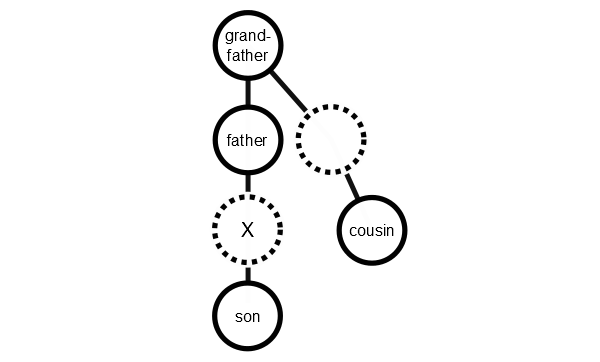
All of these considerations suggest that many readers of Isidore have, over many centuries, been stumbling into a categorization error where they substituted the matrices for the ramusculi which both Isidore and Latin-speaking legal scholar during Late Antiquity would actually have had in mind. The stemma Isidore might have drawn would have probably looked like the following, whereby the dotted roundels represent persons not explicitly in the definition:
One only needs to consider the casual way in which the first-century Latin writer Persius assimilates the ramus to its stemma to see how naturally those branching and the stemma were associated with one another in pre-medieval Latin:
An deceat pulmonem rumpere uentis stemmate quod Tusco ramum millesime ducis censoremue tuum uel quod trabeate salutas? (Saturae, 3.28. See English translations by Kline and Ramsay.) [*]Ramsay's Loeb translation, "Are you to puff out your lungs with pride because you come of Tuscan stock, yourself the thousandth of the line?" is probably not quite accurate: Persius is more likely to be saying "you're an Nth twig of some ancient stemma." Kline's comes closer: "Would you prefer to burst your lungs boasting, yours is the thousandth branch on an Etruscan tree?"
It is notable that the most scrupulous recent translation into English of the Etymologiae, under Stephen A. Barney,[*]Barney, Stephen A., et al.. The Etymologies of Isidore of Seville. Cambridge: Cambridge University Press, 2006. was careful not to conflate the stemma definition in this passage with the diagrams below it, or to perpetuate this long-lived misunderstanding. It reads:
The family tree that legal advisors draw up concerning lineage is called a stemma, where the degrees of relationship are spelled out - as, for example, 'this one is the son, this one is the father, this one the grandfather, this one the relative on the father's side,' and all the rest. Here are the figures for these relationships [my italics].
Regrettably, other translations down the years have been less wary of the trap awaiting. Mark Reydellet's 1984 French translation explicitly labels the figurae as "stemmata" and his French leaves their status ambiguous.[*]... et ainsi de suite, ainsi qu'on le voit sur les figures suivantes. Reydellet, Marc. Les langues et les groupes sociaux. Paris: Les Belles Lettres, 1984, page 216. I have not yet been able to check how this is handled in another recent translation, [*]Throop, Priscilla. Isidore of Seville's Etymologies. Charlotte: MedievalMS, 2005. issued in 2005 by Priscilla Throop.
It seems far more likely that legal practice in the late Roman period, when Isidore's sources were written, employed two separate types of diagram: on the one hand, an open-form stemma, which was drawn up ad hoc to represent an actual family with personal names, and on the other hand, a fixed-form matrix of kinship terms which was kept as a computational aid, or at least used during lawyerly training, to assist in determining the degree of kinship between any two persons who might be drawn on the stemma drawn from real life.
Unfortunately, we are unable to say with any certainty where Isidore obtained his information about stemmata. Reydellet comments that the most frequent supplier of material in Book IX is Maurus Servius Honoratus, a fourth-century grammarian, but Isidore's note about the stemmata contains no etymology, which would be a hallmark of Servius.[*]Reydellet, pp 18-21. As far as I know, the only surviving instance where Servius uses the word stemma is in a discussion of comparatives in a commentary on Vergil (link at left). (Servius).
One might expect a note about legal practice to come from a legal handbook rather than from a grammarian, and here there is a plausible candidate: the Pauli Sententiae (PS), a widely circulated legal textbook compiled in about 300 CE. This was believed in Late Antiquity to be the work of Julius Paulus, the author of the Liber singularis de gradibus already mentioned above. Isidore twice mentions Paulus as an authority.
The majority scholarly view today is that the PS is not by Paulus, but by another, anonymous author who is referred to, if ever, as Pseudo-Paulus. But of course in Isidore's eyes, the two were one and the same.[*]A brief summary of the current view on the PS can be found in: Corcoran, Simon. “Sententiae of Paulus.” In The Encyclopedia of Ancient History. John Wiley, 2013. Isidore's mentions of Paulus are set out in: Ruggiero, Iolanda. “Gli stemmata cognationum: Pauli Sententiae ed Etymologiae.” In Ravenna capitale. Uno sguardo ad occidente. Romani e Goti, Isidoro di Siviglia, edited by Gisella Bassanelli Sommariva and Simona Tarozzi, 101–16. Santarcangelo di Romagna: Maggioli Editore, 2012. Fritz Schulz's position that the Liber singularis is also a forgery by an undistinguished author is not generally accepted.
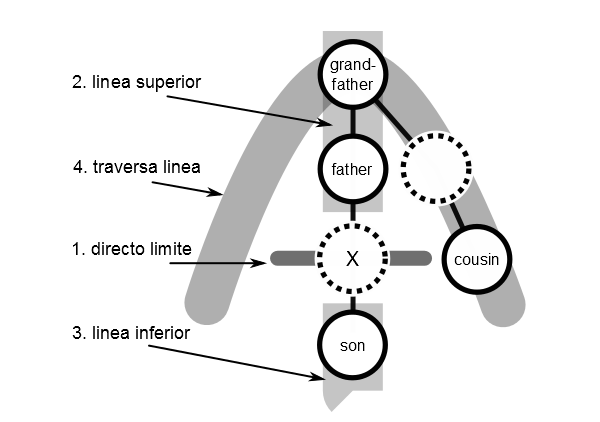
The extant sections of the PS include this, the only known reference in any classical or Late Antique legal text to the stemma in the diagrammatic sense of that word: "The stemmata of cognate relationships are separated by a straight line into two lines, one of which represents the ascendant and one the descendant. From the ascendant there are horizontal lines starting at the second degree."[*]στέμματα cognationum directo limite in duas lineas separantur, quarum altera est superior, altera inferior. Ex superiore autem, et secundo gradu, transversae lineae pendent. Pauli Sententiae 4.11.1A = Digest 38.10.9.
This is a difficult text with no revelation of its purpose. I would argue that it provides a solution to a problem that arises when you have a graphic family genealogy in front of you, have zeroed in on a particular person and are trying to discover the collateral relatives of that person. Someone's siblings and descendants are easy to spot, but identifying the cousins to a particular person is in fact a confusing task, even today for experienced genealogists.
By conducting this procedure, the relevant area of the stemmata cognationum can be virtually partitioned into ascendant, descendant and collateral zones, where one can then isolate the cousins of the person of interest. They are the relatives whose degrees of kinship are always the most difficult to calculate.
I propose that this useful and easily memorized method be visualized from the Latin passage in the order of the image below, where I have numbered the four virtual zones as Ruggiero does. The solution could also be reformulated as: (1) find the ascendant line; (2) go up two steps and then count out the collaterals from there; (3) repeat as needed for the third and higher steps up the ascendant.
This highly technical passage would not have been useful to Isidore, since if would hardly have served Isidore's objective of compact elucidation, but it would be plausible to suppose that the PS must surely have contained simpler material. In particular, it must have commenced its discussion with a simple, accessible definition of the uses of a stemma and what the stemma contains. This is what Isidore would have quoted.
Isidore may well have had access in a southern Spanish library to the complete version of the PS that we lack today.[*]Iolanda Ruggiero reviewed this question in 2012, but she was obliged to concede that Isidore's use of an intact PS simply cannot be proven. Isidore's technical definition of a stemma precisely fits the tone of a popular legal textbook. The most plausible of all Isidore's conceivable sources for IX.vi.28 would be a now-lost section of the PS. It is to be hoped that more study can address this topic.
I have argued in this article that applying the word "stemma" to the arbor juris is a medieval misnomer, for which Isidore's negligence must naturally take some of the blame. In Late Antiquity, a stemma meant what we colloquially call a family tree, whereas some other lost term such as scala was used for the arbor juris.
The extant PS passage tends to support my position, since the passage certainly seems far more applicable to the ramifying family chart, with its oldest ancestor at the top, than it could be to any of the many, variously oriented arbor juris diagrams that were devised under the late Republic and under the Empire. [*] The passage may have been tampered with during the compilation of Justinian's Digest (this being the sole extant ancient work transmitting the passage). See: Liebs, Detlef. Römische Jurisprudenz in Africa. 2nd ed. Berlin: Duncker and Humblot, 2005, page 127. For a comprehensive discussion of the passage, including notes on older literature about it, see Ruggiero op. cit. Drawing on an earlier analysis by the late Yan Thomas of how jurists seem to have read off their listings of the technical language of kinship from a model stemma, she concludes that the passage sections up the Late Antique "tavole genealogiche." This would not have been loosely formed, but would have been drawn up with strict horizontal and vertical axes.
Follow the next two links to see more complex graphic versions of what Isidore, or at least his source, apparently conceived of as a stemma. The first diagram is my schematic depiction comparing a fictitious stemma with a consanguinity table (the triangular type or arbor juris, from the Etymologiae, also known as Schadt Typ 4), side by side. In the second example, two medieval real-life diagrams of precisely the type which Isidore had in mind are reproduced. The page is a plot from the Pruem Monastery imperial-descent chart now in the Trier Stadtbibliothek. The diagram in the left half is the Stemma of Cunigunde. The right half of this panel is a diagram drawn up in 1043 in the court of the Germanic Emperor Heinrich III to demonstrate that the emperor's planned second marriage to his third cousin Agnes would be consanguine and therefore incestuous. (Heinrich and Agnes ignored the warning and got married anyway.)
If my argument above is correct, Isidore's stemma definition needs to be seen in a fresh light: as the most important witness we have to a routine but otherwise unattested use during western antiquity of twiglike diagrams named stemmata to graphically portray the connections among named persons within real-life families.
Similar stemmatic diagrams were demonstrably used by Cassiodorus and Boethius in more cerebral matters of philosophy.
Given this obscure, technical use of the word in Late Antique Latin, I would argue that it is fitting and appropriate to retroactively confer the name of Great Stemma on the fifth-century diagram of pre-Christian time discussed in my other articles. This two-metre-wide chart is much more than a simple stemma, but it is based on graphic visualization techniques that were current at the time it was made and is best understood as rooted in stemmatic-drawing practice.
Back to History Table of Contents
Back to Macro-Typography on the Web
© 2009-2015 Jean-Baptiste Piggin. No copying permitted.